By Dana Whitfield
As Gen Z trades smartphones for flip phones and vinyl, Richard Ettinger’s “The Briscoe Situation” hands both boomers and their grandkids a wickedly funny passport back to the analog age.
Something strange is happening at the checkout counter. In the first week of January 2026, global sales of “dumbphones,” the stripped-down handsets that do little more than call and text, jumped 68 percent. Vinyl records blew past a billion dollars in sales last year. Film cameras, wired headphones, paper planners, and CD players are all moving again, and the buyers are not nostalgic retirees. They are teenagers and twenty-somethings. Analysts now put Gen Z’s appetite for all things analog at a $5 billion market, a full-blown revolt against the roughly seven hours a day the average young person spends staring at a screen.
What they are really chasing is a feeling: what life was like before the feed. As it happens, a novel that shot to number one on Amazon in late July has that feeling in spades, and it comes with a body count.
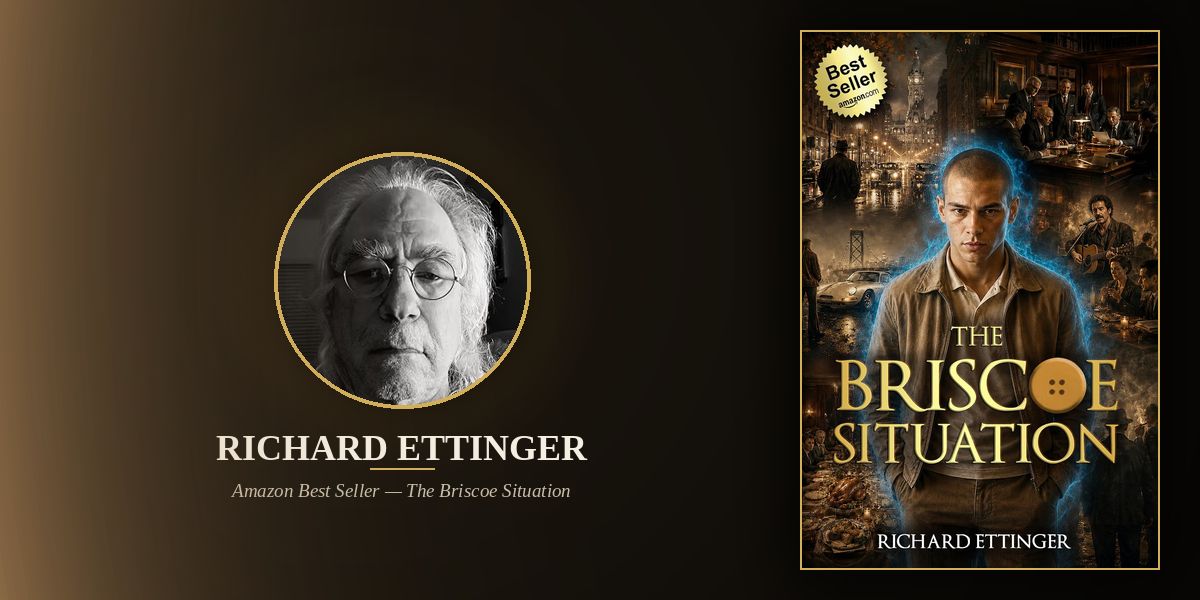
“The Briscoe Situation,” the second novel in Richard Ettinger’s Briscoe Continuum, blends satire, humor, suspense, and paranormal elements in a story that is gloriously hard to categorize, which turns out to be part of the fun.
Set in the autumn of 1964, the book is narrated by Julius Truman Briscoe, a culturally Jewish, agnostic eighteen-year-old from just outside Philadelphia who happens to be, by his own account, “a multimillionaire, the owner of several thriving businesses, a made man in the Jewish mafia, and a fearsome psychic assassin.” The voice is fast, funny, and gleefully hardboiled, a teenage narrator with the mouth of a lifelong wise guy and the ability to drop a man where he stands using nothing but his mind.
What lifts the book above its caper premise is its world. Ettinger rebuilds a vanished America in loving, granular detail: Trailways buses and the Reading Terminal Market, transistor radios and K-Mart shopping plazas, a time, as he writes, when “telephones couldn’t fit in your pocket” and people “got their news from one of three television networks.” “There was no internet,” he reminds us. “No automatic conformity, no Facebook, Instagram, TikTok, or any of that.” For readers drowning in exactly those things, it reads less like historical fiction than like a vacation.
Ettinger, a baby boomer himself, knows precisely who is reading over his shoulder, and he has fun with it. In a mock warning to younger readers who might not catch his references, he suggests they “reach out to the baby boomers in your address book,” or, failing that, “visit a nearby Seniors’ Center for a consultation.” “We old folks have little else to do,” he deadpans, “so we’ll be glad to help you young’uns out.”
That single joke is the whole crossover in miniature. Boomers will read “The Briscoe Situation” and recognize the furniture of their youth. Their kids and grandkids, the same ones buying flip phones and spinning records, get a guided tour of the pre-digital world from someone who actually lived there. It is a rare book engineered to be handed down the stairs and back up again.
It is no accident that the novel opens with an epigraph from Bob Dylan, the very 1960s icon rediscovered by another generation of free thinkers. Ettinger is writing straight into that crossover moment, betting that a Gen Z fascinated by the analog past and a boomer generation eager to explain it can meet on the page, ideally while laughing. The satire is sharp, the mayhem is cartoonish, and the supernatural hook, a hitman who can read and rewrite minds, keeps the thriller engine running hot.
The analog revival was always about more than gadgets. It is a search for something that feels real, made, and a little dangerous, the opposite of an algorithm. “The Briscoe Situation” offers all three. The kids, it turns out, were right to be curious about what they missed
“The Briscoe Situation” by Richard Ettinger is available now on Amazon. Learn more at richardettingerauthor.com.