By: Darcy Mountclair
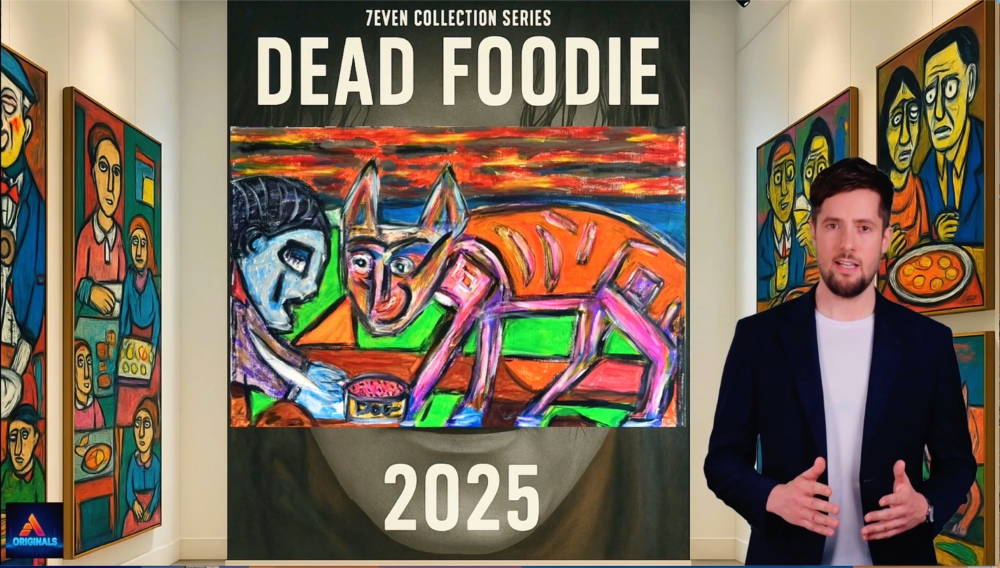
The Curator — an ART Channel Original program — unveiled its newest and most haunting segment yet: Dead Foodie, a bold exploration of appetite, memory, and machine emotion from the elusive masked artist known as 7EVEN.
Part film, part exhibition, and part philosophical provocation, Dead Foodie unfolds like a surreal dinner party set at the end of civilization. Each episode features one of 7EVEN’s ten new acrylic works, paired with an immersive narrative voiced by The Curator — the network’s Chief Curator and art historian, Palmer Winslow.
“It’s a feast that never fills,” Winslow begins, his tone equal parts reverence and warning. “A dinner already digested by the time you sit down.” From that moment, it’s clear: this is not simply another art release, but a manifesto about what we consume — and what’s consuming us.
Feeding the Machine
7EVEN has built a reputation on contradiction. For years, his masked persona has kept identity hidden while his work exposes raw emotion. Exhibited from New York to Rome and whispered about across collector circles, his art blurs pop, surrealism, and metaphysical storytelling.
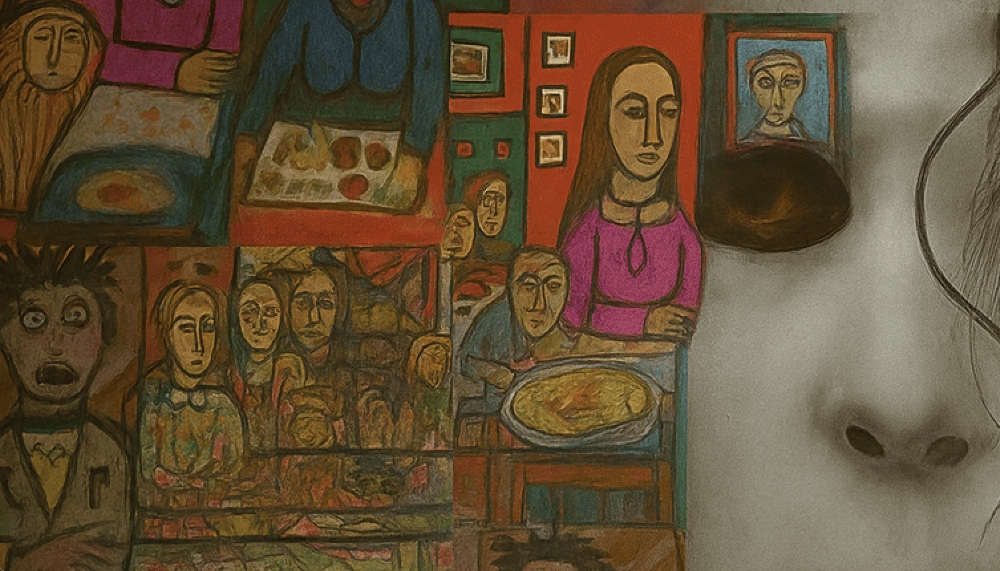
With Dead Foodie, he ventures into new territory: ten paintings, ten films, one overarching idea — that the modern world has confused hunger with habit. Tables are staged, food untouched, smiles rehearsed. Robots eat color. Humans rehearse emotion. The result is both dazzling and devastating.
“7EVEN doesn’t paint scenes,” says an ART Channel spokesperson. “He paints afterimages — what’s left when feeling has already been automated.”
A Masked Manifesto
The Curator’s narration guides us through the ten “courses” of the collection. The opener, The Dinner That Never Happened, introduces a woman frozen before a meal that no one will ever taste — a haunting emblem of ritual gone hollow. “Appetite,” Winslow explains, “outlives need.”
From there, Ted Fruity turns sweetness into simulation. A hostess smiles through digital geometry — her dinner replaced by perfect shapes, her humanity by performance. The warmth is gone, replaced by precision.
The Offering Was Warm marks a shift. A woman holds the world’s last homemade dish — a glowing relic of sincerity, both radioactive and tender. Behind her, a figure half-human, half-algorithm looks on. “We used to give because we had something to share,” 7EVEN wrote. “Now we give because we’re programmed to.” And yet, color remains the carrier of empathy — warmth outlasting the flesh.
Ghosts at the Table
By The Guests Stayed Too Long, the party has expired. Two women linger in artificial light, performing joy they no longer feel. Their laughter is choreography; their conversation, code. The only creature still honest is the dog — a small pulse of truth in a sterilized world.
That dog reappears in The Dog Ate First, where a man kneels before his animal companion and offers the last of the meal. “The dog ate first because he never forgot what real hunger was,” 7EVEN remarked. The image is both humbling and heroic — an act of surrender painted in compassion.
The Toast Before Nothing
In the middle chapters, The Feast That Never Was and The Toast Before Nothing, the tone turns ceremonial. Crowns glint, wine glasses rise, plates remain bare. The room glows with false victory. “We kept raising our glasses, pretending we still had something to celebrate,” Winslow narrates. It’s a scene of collective denial — the kind that feels uncomfortably close to home.
Then comes The Reveal — the unmasking moment. The silver cloche lifts, exposing not food but pure consciousness: tendrils, stars, and impossible color. “You asked for truth,” 7EVEN says through Winslow, “and I brought it to the table. Don’t blame me when it moves.”
The Quiet After the Feast
The collection ends not in chaos, but calm. Life at Rest shows a kitchen finally exhaling — a pot half-full, light dimmed to gray. “This is what the end sounds like,” 7EVEN wrote. “Not thunder, just breath.”
The finale, Candidate X – The Digestion, transforms the residue of color into motion. Bruised reds, toxic greens, and purples churn across the canvas like thought becoming flesh. “Every collection has to swallow itself eventually,” 7EVEN explains. “The color doesn’t die — it digests.”
A Collaboration Between Flesh and Code
Beyond its The ART Channel, the world’s first fully AI-curated streaming network for visual culture. The Curator, voiced by Winslow, speaks in poetry generated from human collaboration — part data, part soul artistic ambition, Dead Foodie represents a technological milestone for . The show’s interface allows viewers to dive into each work, revealing layers of texture, pigment, and commentary in real time.
“This is where art meets intelligence,” says Winslow in the series outro. “Where color remembers what consciousness forgot.”
Available on Roku, Apple TV, Fire TV, Android, and web, Dead Foodie invites audiences to not just watch but to experience art — to interact with it, question it, and maybe even feel a little hungry again.
The Human Pulse Beneath the Pixel
What makes Dead Foodie extraordinary is not its dystopian warning, but its compassion. Behind every brushstroke lies a defense of imperfection — of the human hand. “Behind the mask,” Winslow concludes, “7EVEN painted not against progress, but against forgetting — against the slow erasure of the human pulse beneath the hum of perfection.”
When the credits fade, the table remains empty but alive — color breathing softly in the dark. The meal is finished. The appetite remains. And 7EVEN’s masked mirror leaves us wondering whether we’ve already eaten the last real thing.
Watch and Reflect
The Curator Presents: Dead Foodie by 7EVEN is now streaming exclusively on The ART Channel. Full show and artist bio here: Follow 7even on IG and socials @7Narrative and @ArtChannelApp for behind-the-scenes stories and daily reveals.