By: Lennard James
America’s economy is changing at extraordinary speed. Artificial intelligence, automation, rising housing costs, technological disruption, changes in the labor market and an increasing emphasis on ownership are redefining what economic security looks like. For African American families and communities, simply participating in this changing economy may no longer be enough. The challenge is positioning themselves to own, build, compete, and prosper within it.
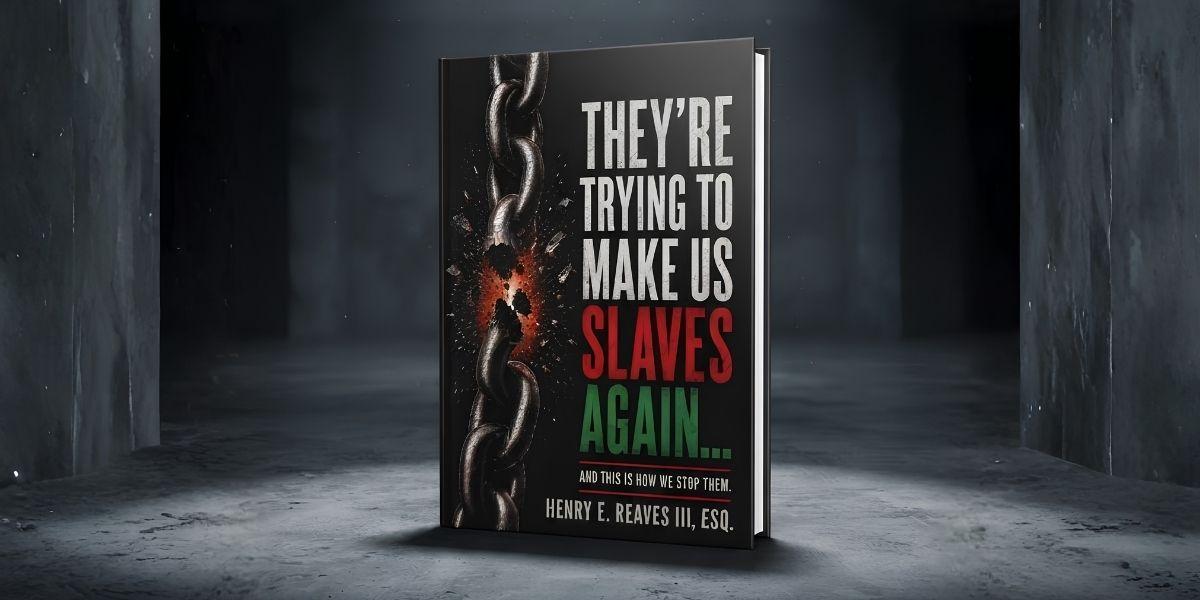
That is the larger conversation behind “They’re Trying to Make Us Slaves Again… And This Is How We Stop Them.” by Attorney Henry E. Reaves, III, Esq.
The book’s provocative title immediately commands attention, but its deeper message is about economic independence, education, awareness, ownership and collective advancement. Reaves challenges African Americans to recognize that the struggle for freedom did not end when physical chains were broken. In a modern economy, freedom must also include having the knowledge, resources and opportunities necessary to control one’s economic future.
The broken chain featured prominently on the book’s cover serves as a powerful metaphor. It represents liberation, but it also raises an important question: Can people be legally free while remaining economically dependent and vulnerable?
challenges readers to think beyond traditional definitions of success. For generations, African Americans fought for access to educational institutions, professions, neighborhoods, voting booths, and economic opportunities from which they had historically been excluded. Those victories changed America. But access alone does not automatically create economic power.
A family can earn a respectable income while accumulating few assets. A community can spend millions of dollars annually while owning relatively few of the businesses receiving that money. A young person can graduate from college prepared to become an employee without ever being taught how to become an employer, investor, or owner.
That is where the message of Reaves’ book becomes particularly relevant.
Instead of simply asking, “How do I get a better job?” African Americans must increasingly ask, “What can I own? What can I build? What problem can I solve? What can I create that has value? And what can I leave for the generation coming behind me?”
That shift from survival to ownership could become one of the most important economic transformations within Black America.
The urgency is intensified by the rapidly changing workplace. Artificial intelligence and automation are already transforming how businesses operate, how information is processed, and how many traditional jobs are performed. Some occupations will change significantly, while entirely new professions and industries will emerge.
African American communities cannot afford to stand on the sidelines of that transformation.
Young people must be encouraged to pursue technology, engineering, healthcare, skilled trades, law, entrepreneurship, finance, science and emerging industries. Established Black-owned businesses must also embrace technology, digital commerce, modern marketing, artificial intelligence and other tools that can help them remain competitive.
The goal cannot simply be surviving the new economy. The goal must be participating in it, competing in it and ultimately owning a greater portion of it.
Education becomes critical to accomplishing that mission.
Reaves’ perspective as an attorney adds to the importance of knowledge. Every day, people sign contracts, obtain mortgages, establish businesses, use credit, purchase automobiles, acquire property, and enter agreements that may affect their financial lives for years. Yet many people enter those transactions without fully understanding the rules governing them.
Financial literacy should therefore become part of preparing the next generation. Young people should understand credit, budgeting, banking, taxes, insurance, investing, entrepreneurship, contracts and property ownership before reaching adulthood.
Legal literacy is equally important. Knowing your rights, understanding your responsibilities and recognizing the consequences of agreements can prevent mistakes that may take years to correct. An informed person is better positioned to ask questions, negotiate and protect his or her interests.
Knowledge, in this context, becomes another form of economic protection.
One of the strongest messages surrounding “They’re Trying to Make Us Slaves Again… And This Is How We Stop Them.” is the importance of moving from consumption toward greater ownership.
African Americans possess tremendous consumer influence. The next challenge is converting more of that economic activity into businesses, property, investments, intellectual property, and institutions that create lasting value within families and communities.
The distinction between consumption and ownership matters. When money is spent solely on consumption, the transaction eventually ends. Ownership, however, can potentially continue producing value. A business can employ people. Property can become an asset. Intellectual property can generate opportunities. Investments can appreciate. Knowledge can be transferred from one generation to another.
This does not mean that everyone must become an entrepreneur or abandon traditional employment. A successful career remains an important path toward economic stability. The larger objective is to avoid depending entirely upon one source of economic security.
Reaves’ message also places responsibility on families to begin thinking generationally.
If every generation starts economically from zero, meaningful long-term advancement becomes much more difficult. Families should consider what they can intentionally build and transfer to their children and grandchildren. That legacy could include a home, business, education fund, investments, insurance protection, intellectual property, or simply the financial and legal knowledge necessary to make better decisions.
The question becomes simple but powerful: What will exist for the next generation because we were here?
That may ultimately be one of the most important challenges presented by Attorney Henry E. Reaves, III, Esq.
His book asks African Americans not only to examine what happened historically, but to decide what happens next. America’s economy will continue changing. Technology will continue advancing. Industries will rise and decline. Individuals and communities with education, skills, capital, ownership, and information will have greater opportunities to shape their own futures.
“They’re Trying to Make Us Slaves Again… And This Is How We Stop Them.” presents economic empowerment as part of the continuing pursuit of freedom.
The broken chain on the cover therefore represents more than liberation from the past. It represents a mandate for the future: learn, build, own, protect, invest, and teach the next generation, because true freedom must include the power to shape your own economic destiny.