By: Jen Appel, Long Island, New York
After three decades in the classroom, one teacher argues that the future of education isn’t a better app. It’s a better bond.
Every year, someone promises me the device, the platform, or the algorithm that will finally transform education. Artificial intelligence. Virtual reality. The next app with the next dashboard. These tools have real value, and I use many of them. But after more than thirty years in classrooms, I have learned something no software update will ever change: children do not fall in love with worksheets. They fall in love with ideas, hope, possibility, wonder, nature, the magic of the universe, giving voice to their ideas, and the pets and people in their community.
Ask any adult what they remember about school and watch what happens. Almost no one describes a quiz. Almost everyone describes a person or meaningful project. The teacher who believed in them before they believed in themselves. The project that made them feel useful to their community. The moment they realized that what they were learning actually mattered outside the classroom walls. Their best friend.
Technology can deliver information faster than any teacher ever could. It cannot look a child in the eye and mean it when it says, “I believe in you.” That is still, stubbornly, and thankfully, a human job.
The wall between subjects was never real
For too long, schools have treated learning like a series of locked rooms. History in one, science in another, art down the hall, and community service filed away as an extracurricular rather than a core part of growing into a good citizen.
The real world was never built that way. History lives in our neighborhoods. Science grows in our gardens. Literature helps us understand ourselves and each other. Art teaches us to see. Service teaches us to care. Separated, these are subjects. Together, they are a life.
Two bears and an accidental revolution
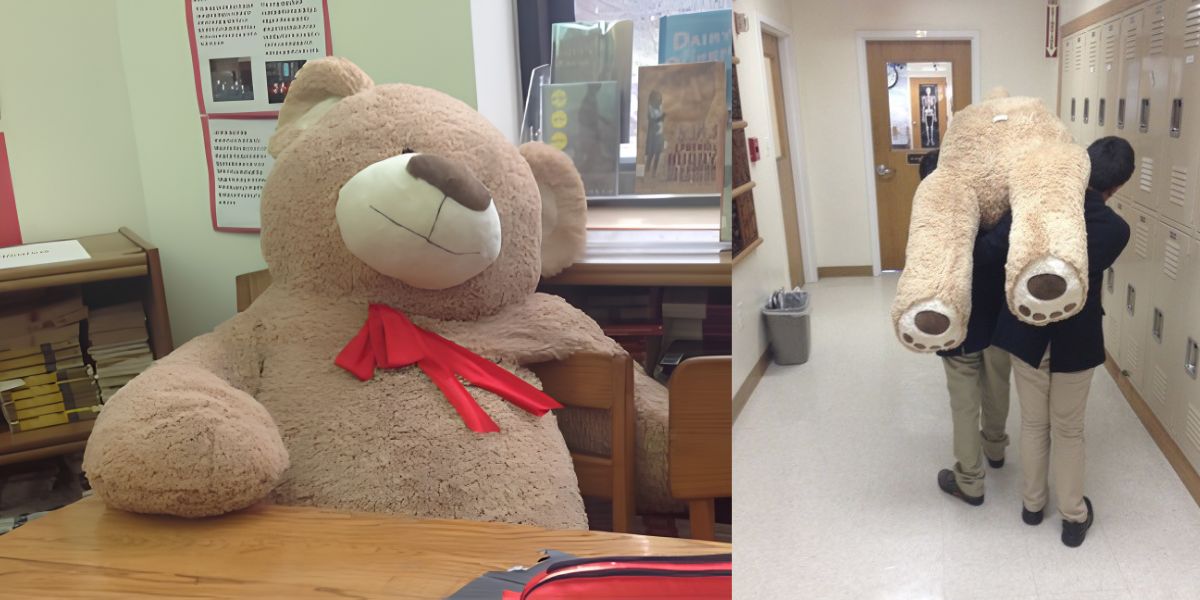
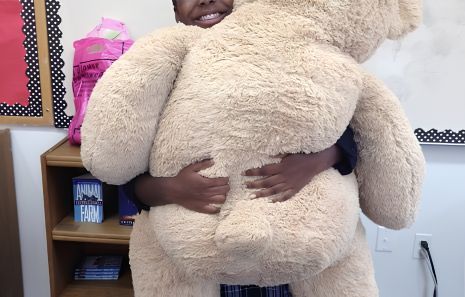
Years ago, I brought two classroom teddy bears into my room. I called them Reading Bear and Writing Bear. The idea was simple: students could take a bear home for the weekend, to Grandma’s house, to the dentist, on vacation. Families photographed the bears’ adventures. Students wrote stories from their own point of view or from the bear’s. Reading Bear doubled as a pillow during independent reading and, according to the students, had strong opinions about plot twists and unreliable narrators.
Then the bears got away from me, in the best possible way. Parents started writing entries. Teachers and Administrators were signing them out for family trips. Reading Bear and Writing Bear turned up in Italy, in Aspen, at grandparents’ kitchen tables. They sat in on Socratic seminars and Harkness discussions like tenured faculty. When the world moved to Zoom, they moved with it, and so did the students’ actual pets, who wandered into frame with the same total confidence. Our community was alive with literacy, poetry, creative writing, story, humor and love, all through two bears.
A stuffed bear did not teach anyone to read. Belonging to something bigger than a worksheet assignment did.
What the dogs already knew
I did not need a classroom to learn that lesson twice. I learned it again on the floor of a senior center in Oyster Bay, New York, where my four Pomeranians, Bentley, Cosette, Honeybear, and Valentine, work as our pack’s animal-assisted visiting team at the Life Enrichment Center. A wagging tail is a remarkably good icebreaker. It gets a resident talking about a dog she had in 1962, and somewhere in that story is a piece of living history no textbook carries. The dogs open the door. The relationship is what walks through it.
That same pack, real dogs living a real Long Island life, became the narrators of my book, 16 Paws & A Special Kind of Grace, set across the historic Gold Coast towns I have always dreamed of calling home. It started as a children’s book. It became something closer to a blueprint.
The 16 Paws pack does not just appear in a story. They do the work. Our poem, “16 Paws of Love,” was accepted into the Locust Valley Library’s poetry anthology, Voices from the Valley, sitting on a shelf alongside work from writers who live and breathe that community. We run scavenger hunts through the historic streets of Oyster Bay, sending families past two centuries of local shops and landmarks, one clue at a time. None of that required a grant, a platform, or permission from a curriculum committee. It required showing up. Every town is a museum nobody has opened yet. Our programming is not just a supplement to the curriculum. It is an opportunity for students to become historians, scientists, and neighbors on purpose before graduation.
The subject nobody puts on the report card
Reading, writing, math, and science are essential, and no one is arguing otherwise. But there is a second curriculum running underneath all of it, one no standardized test measures: empathy, resilience, creativity, communication, curiosity, collaboration, and the quiet confidence that one person can actually change something.
You cannot memorize your way into those qualities. You have to live them. A student builds resilience by solving a real problem, not a hypothetical one. A student builds empathy by sitting across from someone whose life looks nothing like their own and choosing to listen anyway. A student stops seeing themselves as someone who completes assignments and starts seeing themselves as someone capable of improving the place they live.
In a country that often feels like it is pulling apart at the seams, that shift matters more than any test score. Local history tells young people where they came from. Community service tells them where they belong. Creative work tells them what they might build next, together.
Not technology versus tradition. Technology in service of what matters
The future of education was never a choice between screens and story time. It is about pointing every tool we have, old and new, at the same target: relationships, curiosity, creativity, and community.
Let AI personalize instruction. Let virtual reality fly a student to a place they would otherwise never see. Let digital platforms hand a rural student the same resources as a student across the country. I am not against any of it.
But none of it replaces sitting beside a child as they read a story aloud for the first time without stumbling. None of it replaces the look on a teenager’s face after a senior citizen tells them, in detail, what it felt like to live through history the teenager only knew from a chapter heading. None of it replaces a child planting something that will, one day, feed a neighbor they haven’t met yet.
Build schools where children form relationships rather than just finish assignments. Where they discover their own communities instead of memorizing someone else’s facts. Where they become storytellers instead of passive scrollers. Do that, and you have not just prepared them for college or a career.
You have prepared them for a life.
Because children do not fall in love with worksheets or apps.
They crave connection.
And once they find it, they carry it with them forever.
Jen Appel is a veteran educator, author, and learning architect based on Long Island’s North Shore. She is the author of 16 Paws & A Special Kind of Grace, narrated by her four Pomeranians, Bentley, Cosette, Honeybear, and Valentine, and runs the 16 Paws Club, an animal-assisted literacy and community-service initiative rooted in the historic Gold Coast towns of New York.