By Joe Carrollton
For some artists, music is a profession. For Cello, it is a language, one developed not merely through melody and lyric, but through a lifetime of processing the world differently.
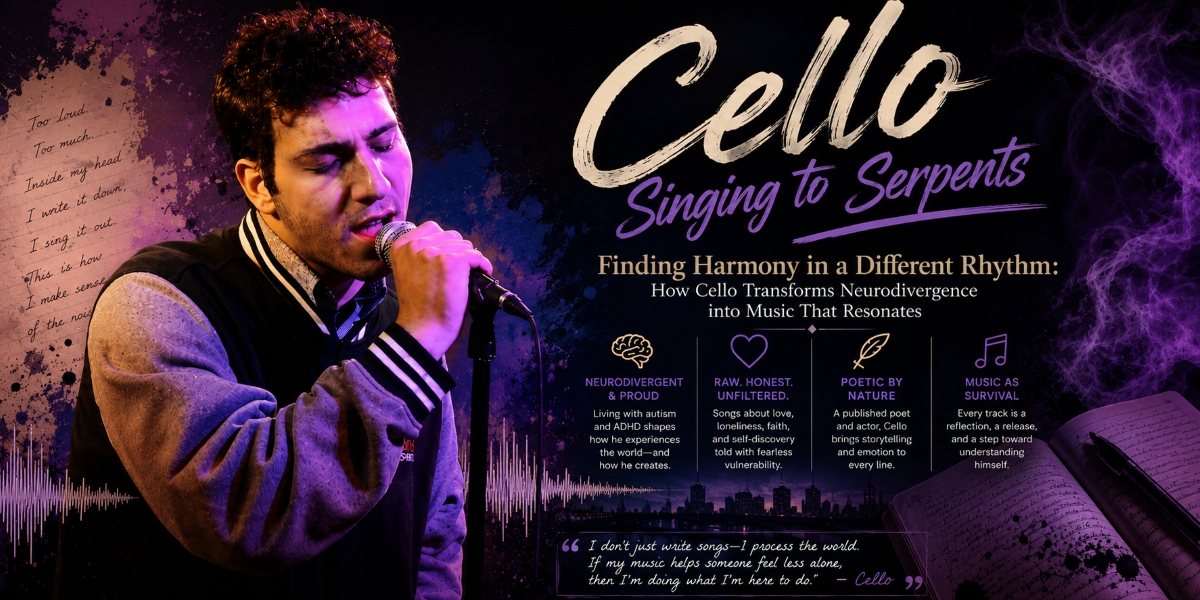
Born Marcello Valletta, the Pittsburgh-based singer-songwriter, poet, and performer has emerged as one of the more compelling independent voices blending alternative music, spoken-word intimacy, melodic rap, and atmospheric pop. Yet what makes Cello’s work stand apart isn’t simply its sound. It’s the remarkable honesty with which he approaches creativity, identity, and the realities of living with Autism Spectrum Disorder (ASD) and ADHD.
Rather than separating his neurodivergence from his artistry, Cello embraces it as an essential part of his creative identity.
That philosophy permeates every aspect of his debut album, Singing to Serpents. Released as a deeply personal statement, the nine-track collection explores relationships, longing, faith, self-worth, obsession, vulnerability, and emotional survival with uncommon openness. It is less an album of tidy conclusions than a portrait of someone learning to understand himself in real time.
Long before recording music, Valletta built his creative life through storytelling. As a published poet and seasoned actor, he became fascinated with the ways language and performance could communicate emotions that ordinary conversation often failed to express. Music became the natural evolution of those pursuits.
That literary background is immediately apparent. Cello’s lyrics often read like journal entries transformed into melodies, filled with vivid imagery and emotional nuance. His songs resist conventional verse-chorus formulas in favor of repetition, evolving thoughts, and conversational confession.
The opening track, “Stay Here,” illustrates that approach beautifully. Centered around the recurring plea, “Won’t you stay here? She said, my lover, my lover,” the song transforms repetition into emotional architecture. Rather than functioning simply as a catchy chorus, the repeated lines mirror the way memory and longing often replay themselves in the mind.
It’s a songwriting style that feels deeply connected to Cello’s lived experience with autism and ADHD.
Many neurodivergent individuals describe experiencing intense emotional focus, heightened sensory awareness, and thought patterns that revisit ideas repeatedly. Those characteristics become artistic strengths throughout Singing to Serpents. Songs unfold like internal conversations rather than carefully edited narratives, allowing listeners to experience emotion as it develops instead of after it has been neatly resolved.
That authenticity extends beyond the music itself.
Cello has been refreshingly candid about the challenges of growing up feeling different. Navigating relationships, understanding social expectations, and managing emotional intensity have all shaped both his personal life and artistic voice. Yet he resists framing autism or ADHD as limitations.
Instead, he speaks of neurodivergence as a different lens through which he experiences creativity.
Hyperfocus becomes meticulous songwriting. Emotional sensitivity becomes lyrical depth. The tendency to notice details others overlook becomes rich imagery that gives his music its distinctive atmosphere.
Tracks like “Faith” reveal this perspective especially well. The repeated declaration, “I need strong faith in my abilities,” feels less like a polished affirmation than a deeply human struggle toward self-belief. It captures the universal challenge of overcoming self-doubt while reflecting Cello’s own journey toward confidence.
Elsewhere, songs such as “Cravings,” “Pray,” and “Full Moon” examine relationships through intensely emotional and sensory lenses. Love is portrayed not simply as romance but as something capable of overwhelming every thought, every memory, every emotion. The result is music that feels immersive rather than merely descriptive.
Musically, Cello refuses to be confined by genre. Alternative pop, melodic hip-hop, spoken-word poetry, and ambient textures coexist naturally throughout Singing to Serpents. The production supports rather than overshadows the lyrics, allowing the emotional honesty of each song to remain at the forefront.
His live performances reinforce that authenticity. Onstage, Cello doesn’t present an exaggerated persona; instead, he performs with an emotional transparency that mirrors his recordings. Audiences respond not because every note is immaculate, but because every performance feels genuine.
That commitment to honesty has begun attracting listeners well beyond traditional genre boundaries. Fans of alternative music appreciate the atmospheric production, while others connect with the vulnerability woven throughout his songwriting. Many neurodivergent listeners have found particular comfort in hearing an artist speak openly about experiences that often remain misunderstood.
In a music industry that frequently rewards image over substance, Cello offers something increasingly uncommon: sincerity. His songs acknowledge uncertainty instead of disguising it. They embrace emotional complexity rather than simplifying it for mass appeal.
Ultimately, Cello’s greatest achievement may not be Singing to Serpents itself, impressive as the album is. It is the example he provides by demonstrating that neurodivergence need not be hidden or overcome to create meaningful art. Instead, it can become a source of insight, empathy, and originality.
For Cello, music isn’t about escaping who he is.
It’s about finally allowing the world to hear him exactly as he is, and discovering that authenticity can be its own kind of harmony.