By: James R. Bennett
There has always been a curious contradiction at the heart of rock ’n’ roll. The music celebrates freedom, individuality, and the exhilarating possibility of escaping life’s limitations. Yet some of its most enduring songs concern people who discover that the very things they embrace as symbols of freedom can eventually become their prisons. Alcohol has played a particularly complicated role in that history, providing generations of musicians with both inspiration and destruction.
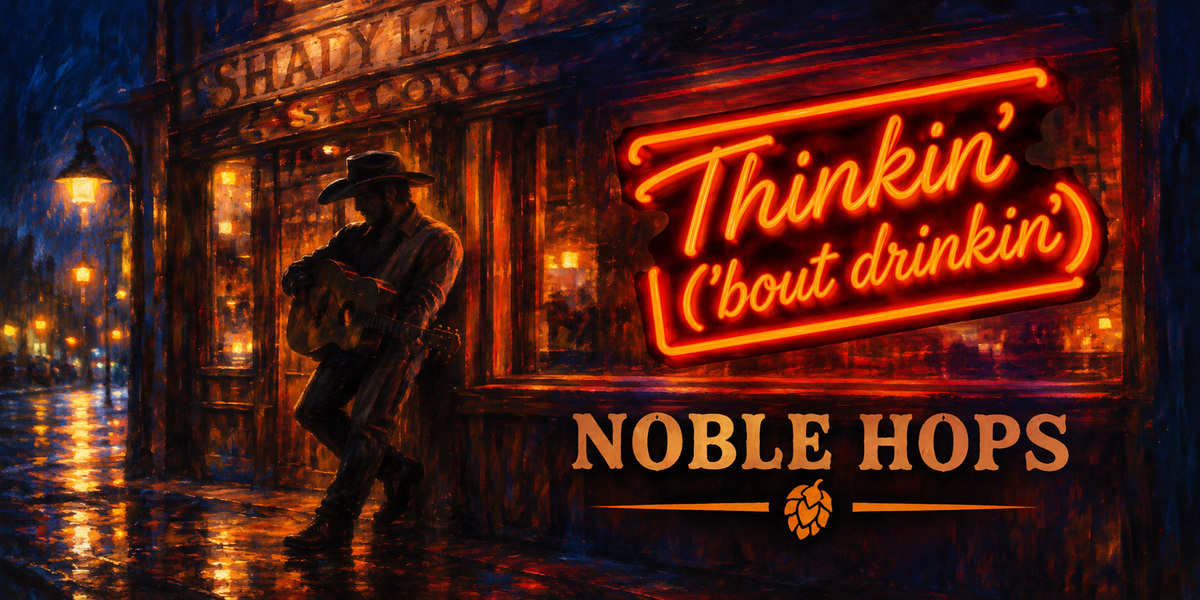
Pittsburgh-area rock band Noble Hops explores that contradiction with its single “Thinkin’ (‘Bout Drinkin’),” released October 10, 2026. What initially appears to be another entry in rock’s extensive catalog of drinking songs gradually reveals itself as something more personal: a portrait of a man struggling with regret, emotional isolation, and the realization that his attempts to escape life’s difficulties have only compounded them.
The song’s greatest strength is its willingness to examine ordinary human weakness without disguising it as romantic rebellion.
Written nearly two decades ago, “Thinkin’ (‘Bout Drinkin’)” originated during singer-guitarist Utah Burgess’s time with B.U.M., a band whose name represented its members Bruce, Utah, and Marty. Burgess composed the music and collaborated on the lyrics with former bandmate Marty Roppolo.
Its revival by Noble Hops is significant because the subject has lost none of its relevance. If anything, the growing public recognition of the relationship between substance abuse and emotional well-being gives the composition additional resonance.
Burgess has been clear about his intentions. Despite fronting a band named after an essential ingredient in beer, he isn’t interested in condemning everyone who enjoys drinking. His concern is what happens when an occasional pleasure becomes an emotional necessity, particularly for people who use alcohol to avoid confronting unresolved problems.
That distinction separates the song from the countless moralizing compositions that mistake judgment for understanding.
The opening verse establishes the narrator’s situation with unsettling directness. He’s drinking straight from the bottle, following liquor with beer, and gradually surrendering control over his behavior.
There is no effort to make him appear heroic or particularly sympathetic. Instead, listeners encounter someone whose judgment has become unreliable and whose actions are beginning to threaten the relationships and values that once gave his life stability.
Then comes the chorus:
“Now I’m thinkin’, ’bout drinkin’ / And I’m drinkin’, to keep from thinkin’.”
The lines are memorable because they express a complicated emotional condition through remarkably simple language. The narrator drinks to escape his thoughts, only to discover that his drinking creates additional reasons to worry.
It’s a cycle that offers temporary relief without providing any lasting solution.
Some of the most powerful songs in American popular music have depended on precisely this kind of direct expression. The blues, country, and rock traditions have repeatedly demonstrated that emotional truth doesn’t require elaborate imagery. Sometimes the simplest observation reveals the most difficult reality.
Musically, Noble Hops approaches the material through its harder rock identity. Burgess handles vocals and electric rhythm guitar, Tony Villella contributes electric rhythm and lead guitar, Johnny “Sleeves” Costa supplies bass, and Brad Hurlburt provides drums.
Recorded at Rattle Clack Studio, the single was engineered, produced, mixed, and mastered by Jazz Byers, with Burgess serving as co-producer.
The guitar-driven approach places the band within a tradition of American rock music that values direct communication between performers and listeners. Rather than allowing an elaborate concept to overshadow the narrative, the song relies on the essential elements of a rock band to carry its message.
But the composition becomes considerably more affecting when the narrator confronts the loss of a relationship.
A woman who once promised love and companionship has disappeared. The realization arrives only after he sobers up, suggesting that his drinking has prevented him from understanding the damage unfolding around him.
It’s a familiar story, but Burgess and Roppolo introduce an important reversal.
Popular music has frequently portrayed alcohol as the refuge of someone abandoned by a lover. Here, the narrator must consider whether his own behavior has driven that lover away.
The distinction changes the emotional meaning of the song. Instead of inviting listeners to share in the narrator’s resentment, it asks them to recognize his responsibility.
Yet there is compassion in the storytelling. The narrator isn’t presented as someone beyond redemption. He’s a flawed individual who appears increasingly aware of the distance between the person he wants to be and the person his actions reveal.
His fear that his true colors might emerge suggests a deeper struggle involving shame, insecurity, and the difficulty of accepting personal shortcomings.
That emotional vulnerability gives the song significance beyond its drinking theme.
The October 10 release date, coinciding with World Mental Health Day, reinforces the connection between substance use and psychological distress. Burgess has acknowledged that drinking sometimes becomes a form of self-medication for difficulties that remain unresolved beneath the surface.
The song doesn’t attempt to explain addiction in clinical terms, nor does it offer a convenient solution. Instead, it concentrates on the experience of someone caught between temporary escape and lasting consequences.
That restraint is important.
One of the recurring weaknesses of socially conscious popular music is its tendency to replace storytelling with instruction. Noble Hops avoids that problem by allowing the narrator’s circumstances to communicate the message.
There are no lectures, dramatic interventions, or artificially uplifting declarations.
The relationship remains broken. The narrator’s uncertainty persists. The destructive cycle has not necessarily ended.
Such an unresolved conclusion may frustrate listeners accustomed to songs that promise emotional transformation before the final chorus. But it also reflects an important reality: recognizing a problem is often only the beginning of confronting it.
For Noble Hops, “Thinkin’ (‘Bout Drinkin’)” also represents an interesting step in the band’s development. Known for its energetic live performances and traditional rock influences, the group demonstrates that familiar musical structures can provide a meaningful setting for complicated emotional subjects.
The song doesn’t require musical reinvention to justify its existence. Its value comes from the sincerity of its premise and the recognizable humanity of its central character.
Ultimately, “Thinkin’ (‘Bout Drinkin’)” belongs to a longstanding American songwriting tradition that examines the difference between the lives people imagine for themselves and the lives they actually lead.
It recognizes that freedom can become dependency, pleasure can become punishment, and love can disappear while someone is looking for relief in all the wrong places.
The Verdict: Noble Hops delivers a thoughtful, emotionally grounded rock single that finds considerable meaning in a familiar subject. Its most compelling quality is the recognition that the consequences of drinking aren’t always dramatic or public. Sometimes they’re measured in quiet rooms, unanswered promises, and the absence of someone who once cared.
And perhaps the song’s most enduring message is that the hardest truths aren’t necessarily found at the bottom of a bottle.
They’re waiting when the bottle is empty.