By: Audrey Denise B. Cachuela
When The Queen’s Gambit premiered on Netflix in October 2020, it became the platform’s most-watched scripted miniseries within four weeks (Source: Wikipedia, 2026). Chess boards came out at home soon after, and on January 20, 2023, Chess.com logged ten million active members in a single day (Source: Chess.com, 2023). Television had been cheering for the genius kid for years by then, with Young Sheldon following a child prodigy through seven seasons on CBS (Source: Wikipedia, 2026).
Somewhere along the way, being the smart kid started to look a lot like being the star player. Real students now treat academic contests the way earlier generations treated tournaments, and the American Mathematics Competitions alone draw over 300,000 students every year (Source: arXiv, 2024).
Pencils Down
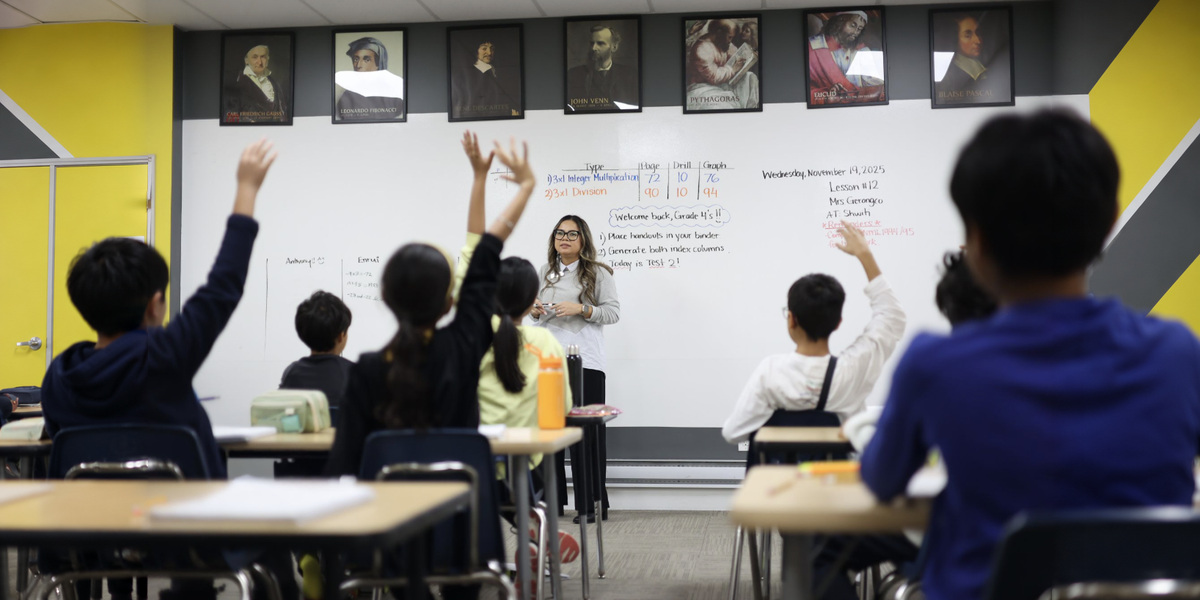
Kim Langen, Co-Founder and CEO of Spirit of Math, has described what this looks like from inside a contest hall. Over 150 students from grades 3 to 12 have just finished writing a math contest. The papers are being collected, legs and hands are fidgeting, and anxious parents are waiting outside the doors.
Then someone says, “Okay, now you can talk,” and the room erupts. Students turn to each other with “How did you do this one?” and “I got 2 for question number 4, what did you get?”
These were Spirit of Math students who had chosen to miss a morning of school for the chance to compete in something they get excited about. In Langen’s account, that something was math.
Why Math Competitions for Kids Feel Like a Sport
Langen’s explanation is simple. Many students, she writes, “think of it as another sport,” one “in which they too can enjoy competitively.” The reason is the same one that keeps a kid on the soccer field after practice ends: “They love it because they know they’re good at it, and want to show what they can do.”
Anyone who has watched a hockey game or a swim meet will recognize the rest of the picture. There are nerves before the start and a stretch of total focus. The moment it is over, relief arrives and everyone starts replaying it with teammates. Kids who compete in math get all of that, plus the satisfaction of cracking something hard with nothing but their own thinking.
William Hawkins is a math educator who hosts the AMC at his school, and he sees the same pull from the front of the room. He says contests build problem-solving skills, resilience and a sense of mathematical play. He also says they give students a shared experience that connects them to a larger math community (Source: Mathematical Association of America, 2025). The chatter in Langen’s hall is that community in action.
Healthy Competition and the Testing Frenzy
Langen is clear that contests carry great benefits “as long as the focus is on learning.” The trouble starts when adults lose sight of that. “So often teachers, parents and students get caught up in the testing frenzy, studying and teaching to the contest,” she writes. When the focus is only on how to do the next question, the real value of the contest gets lost.
Her alternative is to teach the skills behind the problems so a child can handle questions they have never seen before. One of her Grade 3 problems shows why that matters. Brian Bunny is reading a book called How to Grow Your Own Carrots. He starts at the top of page 8 and reads to the bottom of page 20. How many pages did he read?
Most people say 12, because 20 minus 8 is 12. The answer is 13. Brian read page 8 too, so the real count is 20 pages minus the 7 he never opened. Getting to 13 means picturing what Brian actually did, and that is a skill a child carries into every word problem after this one.
A Grade 4 problem from Langen tests the same habit in a different costume. A clock takes 30 seconds to strike 6 o’clock. How long does the same clock take to strike 11 o’clock, assuming each strike is instantaneous? The tempting answer is 55 seconds, and the correct answer is 60. Six strikes have only five gaps between them, so each gap lasts 6 seconds, and eleven strikes have ten gaps. Langen says her teachers often encourage students to draw out what is happening, and a quick sketch of the strikes makes the answer obvious.
You can try either problem at home. Ask your child to solve it and then explain the answer out loud. Explaining a solution helps students develop key mathematical insights, and it lets the adult catch a misunderstanding right away (Source: What Works Clearinghouse, 2021). If your child can tell you why the answer is 13, or sketch the clock and show you the ten gaps, the skill is theirs.
When the focus stays on skills, Langen says, a contest becomes a chance to see how well those skills have developed and how well the concepts are understood. Students also learn to take a risk, and they get pushed to do more than they thought they could.
Practice With a Purpose
Practice still matters, and Langen is direct about it: “practicing math drills is critical for developing math skills.” She compares it to sport as well. “I always say that asking a student who doesn’t have an automaticity or fluency of number facts to do math, is like putting a student with crutches into a running race.”
What separates useful practice from test cramming is how it is done. Langen calls the old-fashioned sheet of questions, scored by how many a student can finish, “an ineffective and outdated way of doing mathematics.” Good practice has a clear purpose and a goal that is well defined and challenging. It also gives the child a way to see their own progress every single time. A child who can watch their results climb on a graph knows exactly what the work is for, which is the same reason young athletes care about their personal bests.
What Healthy Competition Looks Like at Home
The signs are easy to spot once you know where to look. A child in healthy competition comes home talking about problems, both the interesting ones and the ones that stumped them, and the score comes up later, if at all. Their practice has a purpose they can name, and their mistakes get talked through openly.
The warning signs look different: practice that only rehearses past answers, a child who dreads contest day, or the same argument about prep every week. If that last one sounds familiar, ask your child whether they want less practice or a break from contests. Their answer tells you whether the problem is the workload or the competing itself.
A few habits help either way. Ask what made them want to enter in the first place, whether it was puzzles, friends or plain curiosity. After a contest, ask which problem they would like to try again. If they come home disappointed, let them tell you how the morning felt before anyone mentions a score.
Any child can become the kid who can’t wait to compare answers on question 4. Langen once wrote about a Spirit of Math student whose parent couldn’t believe how far one class a week had taken his thinking. Her explanation for that progress is worth holding onto: “This is not an extraordinary child. This is a motivated child learning in a progressive program taught by great teachers.”