By: Lennard James
Author Perry Richardson is preparing to introduce readers to a provocative story of deception, consequences, faith, friendship and survival with his latest book, Trick-Em Satan. Set against the unmistakable backdrop of Memphis, Tennessee, Richardson’s novel combines urban drama with spiritual conflict, creating a story that challenges readers to consider how the voices people listen to can ultimately influence the direction of their lives.
With the powerful theme “Truth Has No Direction, Only Consequences,” Trick-Em Satan establishes Richardson as an author willing to confront difficult subjects through characters who are complicated, imperfect and shaped by their environments. His storytelling explores street violence, broken families, incarceration, neighborhood rivalries, religion, temptation and the difficult process of learning to distinguish truth from deception.
At the center of the story are Chucky B and Trigger Mane, two young men growing up on opposite sides of Memphis.
Chucky B comes from South Memphis and the Cleaborn Homes community, while Trigger Mane represents North Memphis. Both are introduced as teenagers whose impulsive actions lead to serious consequences. Although they begin their lives separated by geography and the rivalry Richardson describes between North and South Memphis, their paths eventually cross inside the juvenile justice system.
It is there that an unlikely relationship begins.
Initially, the two teenagers recognize each other through the divisions they have inherited. One is from North Memphis. The other is from South Memphis. Yet as they spend time together, those labels begin losing their power. The two eventually develop a friendship strong enough to challenge the neighborhood divisions that once told them they should be enemies.
Through Chucky B and Trigger Mane, Richardson examines how young people can inherit conflicts they did not create.
But Trick-Em Satan goes considerably deeper.
One of Richardson’s most intriguing storytelling devices is the mysterious voice influencing the characters. From the beginning, Chucky B hears a voice that appears to warn, direct and advise him. Trigger Mane experiences a similar influence. At critical moments, however, what appears to be guidance can become deception, and decisions made in seconds produce consequences that may last for years.
That tension is at the heart of Richardson’s title.
Trick-Em Satan asks readers to think about deception beyond the obvious lie. What happens when something destructive sounds reasonable? What happens when anger disguises itself as justice, temptation presents itself as opportunity, or a dangerous decision feels completely justified in the moment?
Richardson turns those questions into drama.
Another major presence in the novel is Reverend Bey, a religious leader whose commitment to protecting children and confronting crime develops after devastating personal tragedy. Reverend Bey operates within a complicated world where ministry, community leadership, street justice and power intersect. His character adds another layer to Richardson’s exploration of morality because the distinction between doing what is right and believing one is right is not always clear.
Richardson does not create a sanitized version of Memphis. His fictional world contains violence, drugs, poverty, incarceration and dangerous choices. At the same time, the story also contains friendship, faith, loyalty, humor, community and the possibility of redemption.
That balance gives the book its identity.
Richardson’s approach reflects an author interested not simply in what his characters do, but in why they do it and what happens afterward.
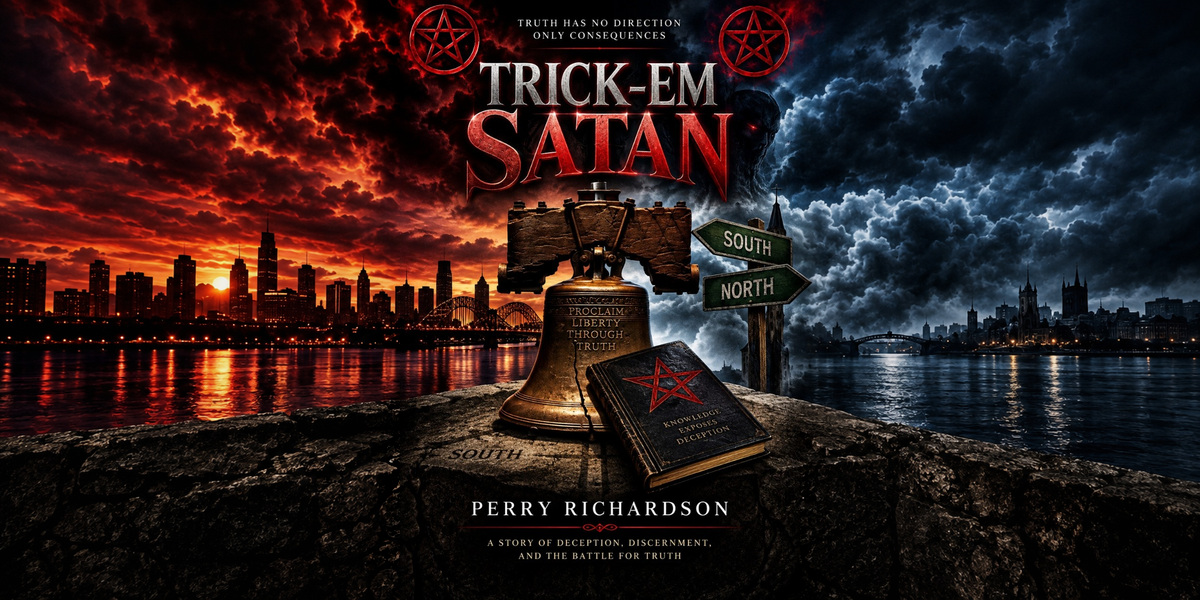
The book’s striking cover reinforces those ideas. Images of North and South point in opposite directions. A cracked Liberty Bell carries the declaration “Proclaim Liberty Through Truth,” while another prominent image declares “Knowledge Exposes Deception.” Darkness and light compete across the Memphis-inspired landscape, visually establishing the spiritual and moral conflict waiting inside the story.
The subtitle further defines Richardson’s message: “A Story of Deception, Discernment, and the Battle for Truth.”
Those words are significant because discernment may be the novel’s most important concept.
For Richardson, knowing that evil exists is not enough. His characters must learn to recognize it when it arrives disguised as something else. That struggle transforms Trick-Em Satan from a straightforward street novel into a broader examination of choices and consequences.
Richardson also uses Memphis itself almost as another character. North Memphis and South Memphis represent more than locations; they become symbols of division. The friendship between Trigger Mane and Chucky B therefore carries a larger meaning. Two young men who are supposed to remain separated discover common ground through shared experiences, eventually creating a bond that challenges the “curse” of neighborhood rivalry described throughout the story.
At the same time, Richardson never suggests that friendship automatically erases the past. His characters carry their histories with them. Childhood trauma follows them. Decisions follow them. Violence follows them. And the voices that once influenced them do not simply disappear because they become adults.
That is where the consequences begin to matter.
With Trick-Em Satan, Perry Richardson is developing a story intended to entertain readers while also making them question what they see, hear and believe. Beneath the street drama is a warning about deception. Beneath the violence is a conversation about choices. Beneath the rivalry is a story about friendship. And beneath the darkness is an ongoing search for truth.
For Richardson, the message is ultimately bigger than North Memphis or South Memphis.
It is about recognizing that every person eventually faces a moment when emotion, temptation, truth and deception collide and the voice they choose to follow may determine everything that happens next.
Perry Richardson’s Trick-Em Satan is coming soon.