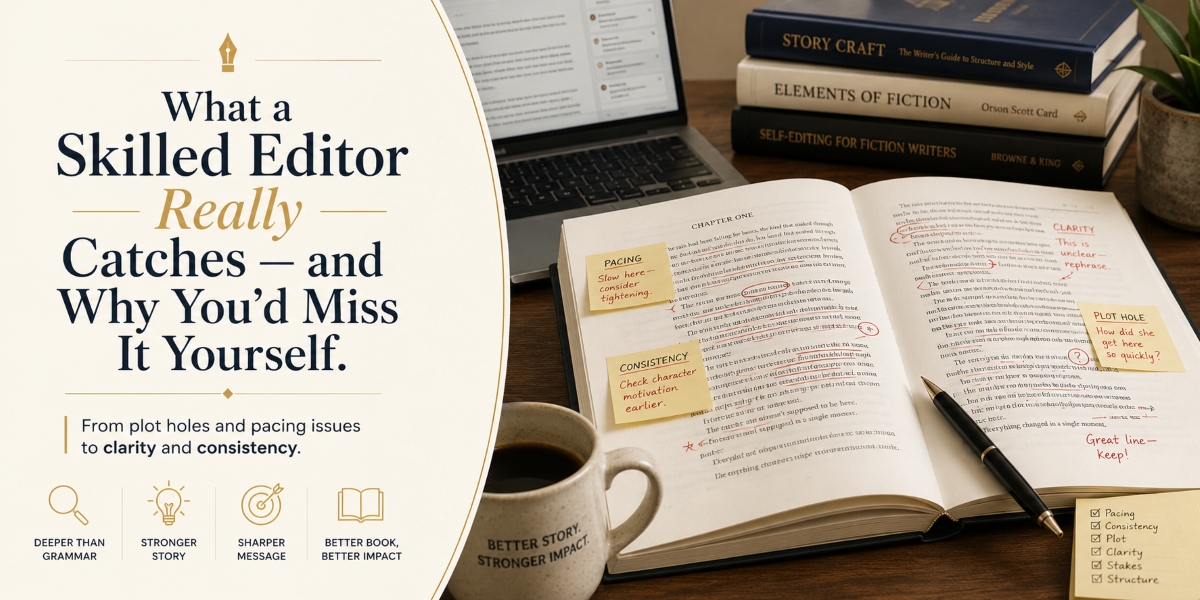
Many authors picture editing as essentially advanced spellchecking, someone going through the manuscript fixing grammar and tidying up sentences. That picture badly undersells what a skilled editor actually does. A great editor catches the plot hole in chapter nine, the character whose eye color changes halfway through, the argument that doesn’t quite hold together, and the long stretch where the story sags and readers start to drift. These are the issues that genuinely determine whether a book works.
This article explains what a professional book editor really catches, why these problems are so hard to see in your own work, and how catching them is the difference between a rough manuscript and a finished book. It covers the substantive, structural issues that quietly cost readers, the reasons authors are blind to them, and how professional editing addresses them while still preserving an author’s voice. Understanding the depth of what editing involves is the first step to appreciating why it’s indispensable.
Editing Is Far More Than Fixing Grammar
Grammar and typos are the most visible part of editing, but they’re a small fraction of what a skilled editor attends to. The deeper and more valuable work happens at the level of the whole book: whether the structure holds, whether the pacing carries a reader through, whether characters and details stay consistent, and whether the story or argument actually delivers on its promise. These are the things that make a book feel either satisfying or subtly broken, and they have nothing to do with comma placement.
A great editor reads the way an attentive, demanding reader would, but with the training to identify why something isn’t working and how to fix it. They notice when a chapter drags, when a plot thread is dropped, when an argument skips a step, when a character behaves inconsistently, or when the emotional beats land in the wrong order. This substantive analysis is the heart of professional editing, and it’s what transforms a manuscript rather than merely tidying it.
The Substantive Problems That Cost You Readers
The issues a skilled editor catches are precisely the ones that quietly drive readers away. A reader rarely puts a book down and consciously thinks “the pacing in the middle act was poorly managed”, they just feel bored and stop reading. They may not articulate that a plot hole broke their trust or that an inconsistency pulled them out of the story, but the effect is the same: they disengage and don’t finish, and they may leave a lukewarm review on the way out.
Lumera Publishing’s developmental editing examines structure, pacing, and internal consistency specifically to find and fix these weak points before any reader hits them. By addressing the sagging middles, the dropped threads, the logical gaps, and the inconsistencies while the book is still in development, the editing removes the very things that would have cost the author readers and reviews. These problems are invisible in their effect but devastating in their consequences, which is exactly why catching them matters so much.
Why You Can’t See These Issues Yourself
There’s nothing wrong with an author who can’t catch these problems in their own manuscript, it’s a near-universal limitation rooted in how the mind works. After spending months or years immersed in a book, an author knows the story and the intended meaning so thoroughly that they read what they meant to write rather than what’s actually on the page. The brain fills in the gaps automatically, smoothing over inconsistencies and holes the author simply can’t perceive anymore.
This is why an objective outside reader is essential, and why even professional authors rely on editors for their own work. A skilled editor brings fresh eyes and no preconceptions, encountering the book exactly as a reader will and spotting the problems the author’s familiarity hides from them. The issue isn’t a lack of talent on the author’s part; it’s the impossibility of being objective about something you’re too close to. Professional editing supplies the objectivity the author structurally cannot.
Beyond Catching Problems: What an Editor Adds
It would be a mistake to think of editing purely in terms of catching problems, as though an editor’s only job is to find what’s broken. The best editing is also additive: a skilled editor sees the potential in a manuscript and helps the author realize it, pointing out where a scene could land harder, where an argument could be sharpened, or where a moment is being underplayed and deserves more room. They don’t just remove what’s weak; they help strengthen what’s already strong.
This is where editing shades into genuine craft collaboration. An experienced editor brings perspective the author can’t have from inside the book, suggesting ways to heighten tension, clarify a theme, or improve the rhythm of how the book unfolds. The result is not just a manuscript with its flaws removed but a better version of the book the author set out to write. Lumera Publishing’s editors work in exactly this spirit, catching the problems an author can’t see while also helping the manuscript become the strongest version of itself, all while preserving the author’s voice.
From Manuscript to Finished Book
Addressing these substantive issues is what turns a manuscript into a finished book. A draft that has had its structure tested, its pacing tightened, its inconsistencies resolved, and its logical gaps closed is a fundamentally different and far stronger thing than the same draft before that work. On top of the big-picture developmental editing, Lumera Publishing also provides line-level polish for clarity and flow, so the book is strong both in its bones and in its prose.
All of this is done while preserving the author’s voice and pairing the edit with constructive feedback the author can genuinely learn from, rather than imposing silent changes. The result is the writing an author can no longer see clearly given the rigorous, objective read it needs, the kind that turns a promising draft into a title that truly holds up for readers. Once the editing is complete, Lumera can move the book into formatting and publishing. Authors ready for a thorough edit can request a quote from Lumera Publishing.
About Lumera Publishing
Lumera Publishing is a full-service, fee-based book publishing company based in New York, USA. The company offers ghostwriting, editing, formatting, cover design, publishing, and book marketing services for authors across every genre, helping writers self-publish professionally while keeping 100% of their rights and royalties.
Learn more at lumerapublishing.com or call +1 (888) 477-8199. Media contact: info@lumerapublishing.com.